Blog
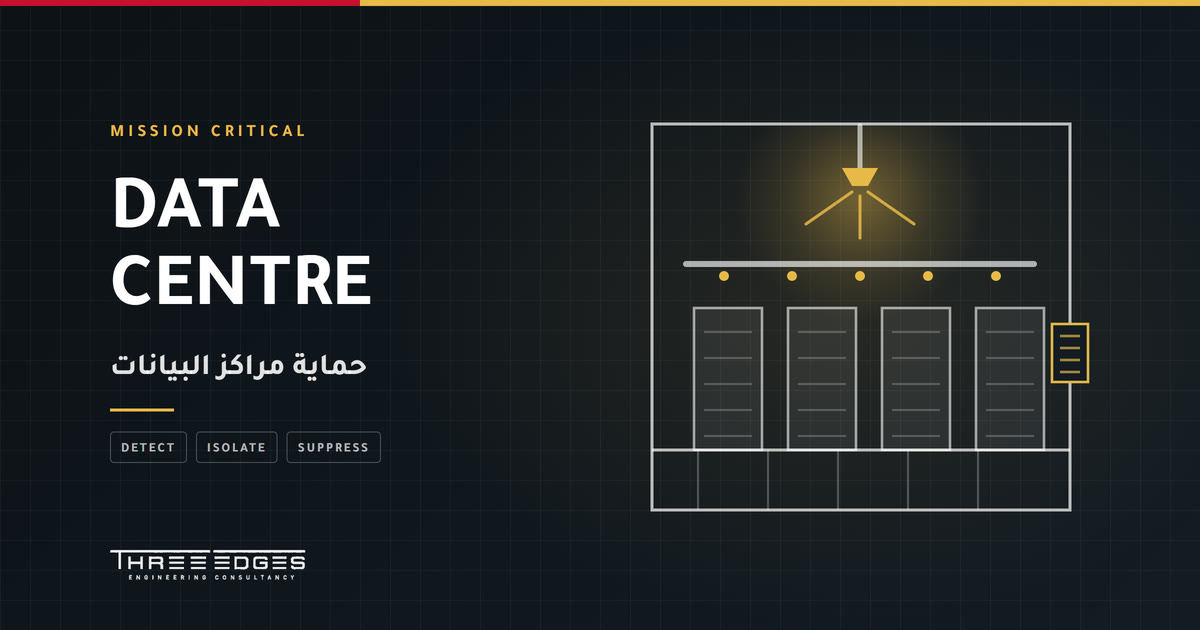
Data Centre and Server Room Protection: Detection Before Suppression
A server room is a special case in fire protection. The fire load is relatively small, but the consequence of any incident is large: service down, data lost, and sensitive equipment that smoke or water can ruin before flame ever reaches it. Worse, the wrong suppression choice can cause more damage than the fire.
So protection here is built in a different order: very early detection first, then isolating the power, then suppression.
Why conventional detectors are not enough
Precision cooling units move large volumes of air continuously, diluting and dispersing smoke long before it reaches a ceiling detector. That is why data centres rely on very high sensitivity aspirating detection, drawing air samples through a pipe network, with the sampling points placed where the air actually goes: at the return air path to the cooling units, within the raised floor void, and inside enclosed containment aisles.
The aim is an early warning that allows a human response — isolating a cabinet, shutting down a unit — before anything reaches the stage of automatic suppression.
Clean agent systems: the measure is hold time
A gaseous system does not succeed simply by discharging; it succeeds if the required concentration stays in the room long enough to prevent re-ignition. That makes the room itself part of the system:
- Room integrity testing at handover, and again after any significant change: new penetrations, containment installed, or cooling modified.
- Common leak paths: the raised floor void, cable penetrations, cooling unit openings, door undercuts, and an unsealed ceiling void.
- Pressure relief: rapid discharge creates a pressure differential that can damage lightweight walls, so calculated venting is needed.
- Interlocks: air conditioning stopped and dampers closed before discharge, otherwise the agent leaves with the air.
Sealing the cable penetrations is not a cosmetic item here; we covered it in detail in firestopping and fire barriers.
The agent does not address the cause
A server room fire usually has an electrical origin. If power stays on at the source, it will re-ignite once the agent disperses — and a gaseous system is typically a single shot. So isolating supply to the affected space must be part of the cause-and-effect matrix and the team procedure, not an improvised decision during the incident.
And sprinklers?
Common practice avoids water-filled systems above live equipment. Where the code or the authority requires sprinklers, the usual answer is a pre-action system in which water only enters after two conditions are met: an alarm from detection, and a sprinkler operating. Offices, corridors and loading areas keep their normal water-based protection.
Lithium batteries: the harder problem
As lithium batteries spread through uninterruptible power supplies, a different hazard appears: thermal runaway inside the cell is not stopped by clean agents, because the reaction sustains itself. The focus therefore shifts to:
- Separation and compartmentation: a dedicated, rated battery room, preferably on an external wall.
- Off-gas and temperature monitoring to raise an alarm before runaway.
- Ventilation and venting designed for an accumulation of flammable gases.
- Limits on the energy stored in a single space.
The numeric values here differ between references, editions and insurers, and are settled early with the authority rather than during construction.
The item that gets forgotten: operations
- An abort station and pre-discharge alarm, with a written procedure for who presses it and when.
- Staff training: a correctly designed gaseous discharge is not a hazard to people, but the noise and rush alarm anyone who does not expect it.
- Refill time after any discharge — the room is unprotected until then.
- Routine testing of detectors and the transport time in the sampling pipework, and of cylinder weights and pressures.
How Three Edges can help
- Reviewing the protection systems design: agent selection, concentration, venting and integrity.
- Fire alarm system design, the cause-and-effect matrix, and tying detection to power and HVAC shutdown.
- The fire and life safety strategy for the whole building, and where server and battery rooms sit within it.
- Assessing existing facilities and reviewing what has changed since handover.
Frequently asked questions
Is a clean agent system enough on its own?
It addresses a fire in its early stage inside a sealed space. It does not address power still feeding the source, a fire beyond the design scenario, or a battery in runaway.
A small server room in an office — what is needed?
At minimum: suitable detection tied into the building system, fire separation from its surroundings, sealed penetrations, and a clear procedure for isolating power. Gaseous suppression is then assessed against the value of the contents and the cost of downtime.
How often is room integrity retested?
At handover, periodically, and after any change affecting the seal. The interval comes from the adopted standard.
Is water mist an option?
It is used in specific applications, and the decision depends on the equipment, the tolerance for wetting, and the adopted requirement; it is not an automatic substitute.
Have a data centre or server room in design or in operation? Request a fire safety review and we will set out the gaps and their priorities.
References
- NFPA 75 and NFPA 76 — protection of information technology and telecommunications facilities
- NFPA 2001 — clean agent fire extinguishing systems, and NFPA 855 — energy storage systems
- Technical article on balancing protection and uptime in data centres
