Blog
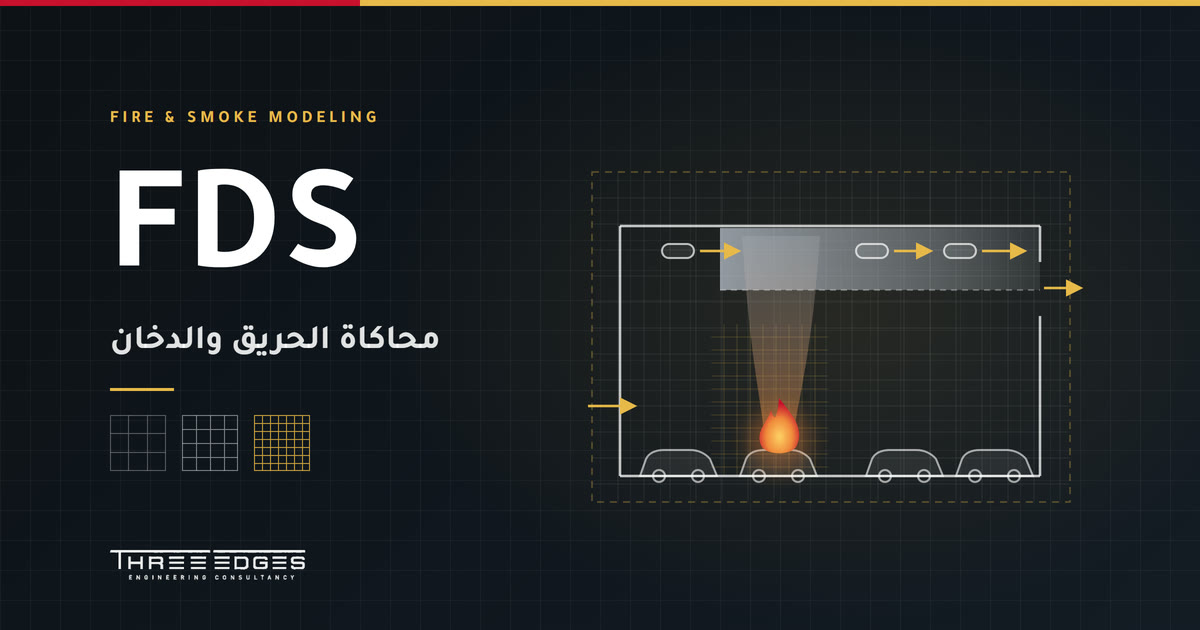
FDS Smoke Modeling: When Atriums and Car Parks Need It
Once a space becomes large or unconventional — an atrium running through several floors, or a wide basement car park — the standard equations stop giving a reliable answer to one question: where does the smoke go, and how long does the escape route stay usable? That is where fire and smoke modeling with FDS (Fire Dynamics Simulator), developed by the US National Institute of Standards and Technology (NIST), comes in: a computational fluid dynamics code written specifically for fire-driven flows.
This article explains when you actually need such a model, what goes into it, how its quality is measured, and which mistakes send a study back to the designer.
What does an FDS model give you?
The code divides the space into small computational cells and calculates how air, smoke and heat move through them over time. What matters to the designer is not the colourful pictures but the measurements at the critical points: visibility, temperature, radiant heat, smoke layer height, and the activation times of detectors and sprinklers.
Those outputs serve three main purposes:
- Establishing the available safe egress time (ASET) and comparing it with the required safe egress time (RSET).
- Verifying how a smoke control system performs before it is built, rather than after the site test.
- Supporting alternative solutions in performance-based design.
Atriums: when the equations stop working
Atrium smoke control is normally designed with the algebraic methods in references such as NFPA 92, and they are enough for typical cases. They lose their validity in situations that come up often:
- When the smoke layer has to be held only slightly above an occupied level, or above balconies open to the space.
- Irregular geometry: sloped roofs, side openings, and spaces communicating with the atrium.
- Make-up air: NFPA 92 limits make-up air velocity to about 1.02 m/s (200 ft/min) where it can come into contact with the plume, and allows a higher velocity where an engineering analysis supports it — in practice, usually a model.
- Wind: openings on different faces can turn the atrium into something like a wind tunnel that breaks up the plume and defeats the system.
Car parks: two very different objectives
A common confusion in car parks is that all ventilation systems are the same, when the difference is fundamental:
- Smoke clearance to assist the fire service: it reduces smoke density and improves the approach to the fire, but it does not promise a smoke-free escape route.
- Smoke control to protect escape routes: a far more demanding objective, and one that usually has to be demonstrated by modeling.
With jet fan systems, air changes per hour are not evidence of performance on their own. What matters is the actual air path: do the fans push smoke towards the extract points, or stir it back into the space? Modeling is what settles fan positions, directions, activation time and the sequence with the detection system.
The design fire itself is set in the fire strategy and approved by the authority. References publish guide values for a vehicle fire (around 4 MW is often quoted), and the value changes with the type of vehicles, how closely they are parked and whether sprinklers are installed, so it should not be copied from another project's study without justification.
Model inputs: where credibility is won
- Geometry: simplified enough to run, detailed enough to represent the space: heights, openings, and obstructions under the ceiling.
- Design fire: the heat release rate curve over time, the peak, and the effect of sprinkler activation on fire growth.
- Boundaries and ventilation: openings, fan curves, ducts and wind pressure.
- Operating scenarios: the worst reasonable cases: a fan out of service, a delayed start, or a door left open.
- Acceptance criteria: the values for visibility, temperature, radiant heat and gases, and where they are measured on the escape route, agreed with the authority before any run.
Mesh resolution: the measure reviewers ask about
The best known measure of FDS mesh quality is the ratio of the characteristic fire diameter to the cell size (D*/δx). Reference sensitivity studies used values between 4 and 16, and values near 10 are considered adequate in many cases. Even so:
- Halving the cell size reduces the discretisation error by about a factor of four, but increases run time by roughly a factor of sixteen, so mesh size is an engineering and a budget decision at once.
- The ratio applies to the plume alone. It does not prove that flow near walls or through openings is resolved, which is why a grid sensitivity study stays part of the report.
- The software version, the input files and the basis for validation are documented, because model results are validated over a limited range of experiments and their applicability to your case has to be argued.
Common mistakes that send a study back
- An optimistic design fire, or one copied from another project without justification.
- A coarse mesh with no sensitivity study, or a fine mesh only at the fire while the rest of the route is neglected.
- Assuming every system works in every scenario.
- Presenting smoke images without numerical measurements at head height along the escape routes.
- Not linking the results to the evacuation time; a model on its own does not demonstrate life safety.
- Agreeing the acceptance criteria after the calculations instead of before them.
How Three Edges can help
Three Edges provides fire and smoke modeling (FDS), including:
- Setting the design fire, the scenarios and the acceptance criteria, and agreeing them early.
- Building the model, running the grid sensitivity study and documenting validation.
- Combining the results with egress modeling to compare ASET and RSET.
- Carrying the study into performance-based design and submitting it to the authorities through to approval.
Frequently asked questions
Does modeling replace the smoke control system?
No. Modeling is a design and verification tool: it helps choose extract rates, opening and fan positions, and demonstrate performance. It replaces neither the system itself nor its commissioning test on site.
How long does a study take?
It depends on the size of the model, the number of scenarios and the mesh resolution; fine runs can take days per scenario. That is why it is best to start early in design, before opening and duct positions are fixed.
Do electric vehicles change the design fire in car parks?
This is a developing subject, and some authorities have begun asking for it to be discussed in the fire strategy. The assumption used is agreed with the authority for each project rather than taken from a general figure.
How is FDS different from general CFD software?
FDS is written for building fires and smoke flow, it is open source and documented, and it comes with published validation guides. General CFD packages need more setup and expertise to represent combustion and radiation in a way suited to fire safety work.
Do you have an atrium, a basement car park or another large space whose smoke system needs to be proven? Request a fire and smoke modeling study and we will set the scenarios and acceptance criteria from the start.
References
- NIST — Fire Dynamics Simulator (FDS) and Smokeview, with its published user and validation guides
- NFPA 92: Standard for Smoke Control Systems
- BS 7346-7 — smoke control systems for car parks
- SFPE Handbook of Fire Protection Engineering
