Blog
Fire Doors: The Certified Door That Does Not Work
A fire door is the cheapest element in a compartmentation system and the one most exposed to interference. It is also the element bought with a certificate and installed in a way that voids that certificate the same day.
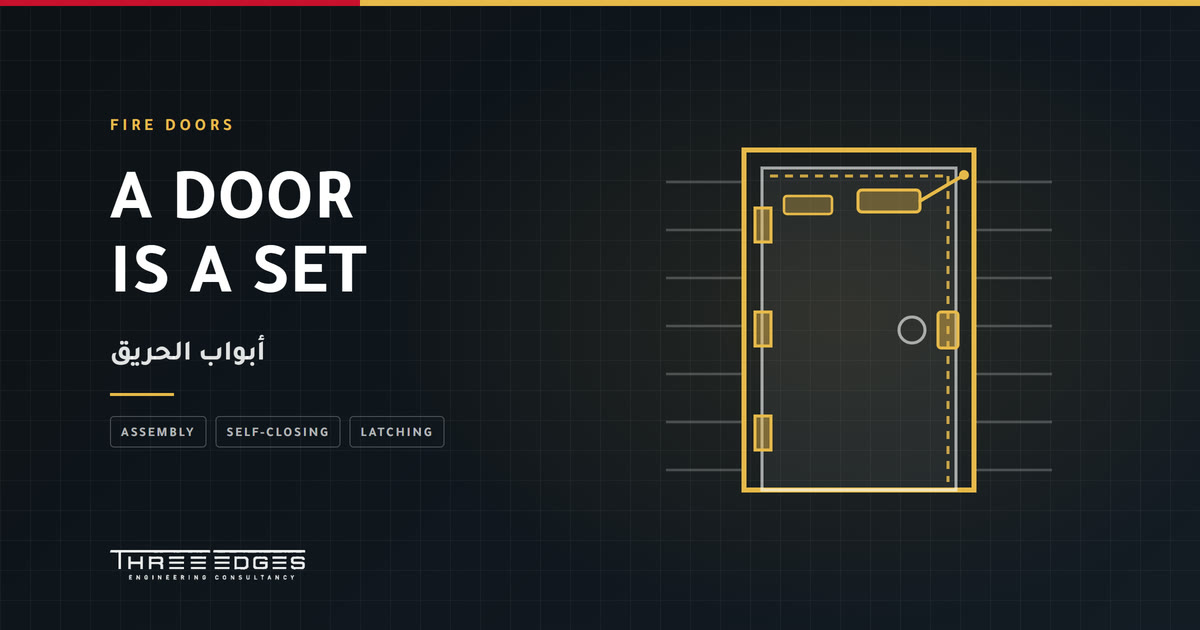
The core idea: a fire door is not a leaf, it is an assembly — leaf, frame, hinges, self-closer, latch, intumescent and smoke seals, and glazing where fitted. It is tested and certified as one set. Swap any component for one the certificate does not cover and the assembly is no longer the assembly that was tested.
What does a fire door actually do?
It maintains the separation between two spaces for a defined period. That separation is what keeps a stair usable during a fire and stops fire spreading from a flat into a corridor and from a corridor into a stair. If the door stands open, the fire-resisting wall beside it is worth nothing.
The same logic applies to any penetration through the barrier, which we covered in firestopping and fire barriers.
What voids the certification?
- A non-matching frame: a certified leaf hung in an ordinary frame.
- Hinges or hardware outside the scope: locks, handles and hinges are part of the test, not optional spares.
- Fixing: the gap between frame and wall is filled with an approved material, not ordinary foam.
- Clearances around the leaf: limits are set by the door's own certification. A door that does not close fully, or a leaf trimmed at the bottom after the carpet went down, falls outside its approval.
- Intumescent and smoke seals: missing, painted over, or cut.
- Openings: any hole made later for cables, a fan, or a vision panel.
So we always ask the supplier for the test evidence for the complete assembly, not a certificate for the leaf alone.
Closer and latch: the two items that always fail
A fire door only protects while it is closed and latched. The two observations that repeat in existing buildings:
- A door wedged open with a chock, an extinguisher or a rope — because the closer is heavy or the ventilation is poor. The right answer is not to remove the closer, but a hold-open device tied to the alarm that releases the door on activation.
- A door that closes but does not latch: it bounces back and sits open by a few millimetres. The field test is simple: open it fully, let go, and it should close and latch on its own.
A fire door in an escape route
Beyond its fire resistance, a door in an escape route carries other requirements: opening in the direction of travel where required, opening with a single action without a key or special knowledge, wide enough for the number of people using it, and not obstructing the route when open.
What repeats in existing buildings is an excellent fire door that gets chained shut at night — turning a protective measure into a cause of death.
Glazing and labels
Glass in a fire door is glass tested as part of the assembly, in a defined size and bead — not any toughened pane. The label on the frame or leaf is what lets any later inspector or engineer know what this door is and who certified it. Removing or painting over it costs the building its evidence.
Maintenance: current condition beats the certificate
A certificate describes the door on the day it was tested. What matters is its condition today. Routine inspection covers: closing and latching, the state of hinges and closer, the integrity of seals, the clearances, the absence of wedges and later additions, and a legible label. It is recorded door by door — not as a general note that "the doors are fine".
How Three Edges can help
- Reviewing the compartmentation design and setting the door locations and requirements for every barrier.
- Codes and standards compliance, including reviewing suppliers' proposed assembly certificates.
- Assessing the existing building: a door schedule, their condition, and the order of repair.
- Fire safety plans showing every barrier and its doors on the drawing.
Frequently asked questions
The door is metal and heavy — is it fire resisting?
Weight has nothing to do with resistance. Resistance is established by test evidence for the assembly, not by the look or thickness of the door.
Can a fire door be held open?
Only with a hold-open device linked to the alarm that releases on activation, or on loss of power. A wedge and an extinguisher are not a solution.
The door does not quite close — does it matter?
Yes, and it is the most dangerous common finding. A door that does not latch lets smoke through and is pushed open by fire pressure.
How often should doors be inspected?
A documented routine inspection at least annually, and more often in high-traffic locations or where doors keep being wedged open.
Want to know the real condition of the fire doors in your building? Request a fire safety review and we will produce a schedule and a priority order.
References
- The Egyptian code for design and execution requirements for protecting facilities from fire
- NFPA 80 — Fire Doors and Other Opening Protectives, including periodic inspection
- EN 1634-1 and BS 476 Part 22 — fire resistance test references for door assemblies
