Blog
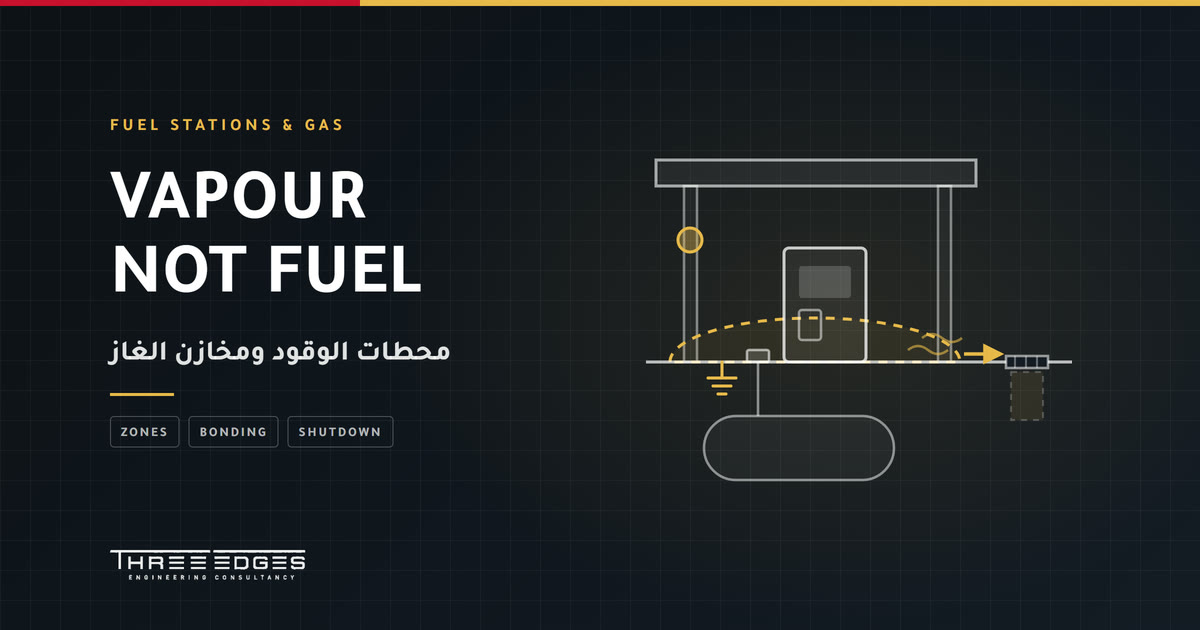
Fuel Stations and Gas Stores: The Hazard Is the Vapour, Not the Liquid
One idea explains most of what fuel station requirements ask for: petrol does not burn — its vapour does. And vapour is heavier than air, so it runs along the ground, collects in low points and gullies, and reaches an ignition source metres away from where the spill happened.
So protecting a station is not about extinguishers. It is about keeping vapour and sparks apart, and every detail follows from that.
Hazardous areas: why any electrical fitting will not do
Around every point where vapour may be present — tank fill points, vent pipes, dispensers — hazardous areas are defined, graded by how likely vapour is to be there. Inside them, only electrical equipment certified for that zone is allowed: lighting, panels, cameras, sockets.
What we find most often in operating stations is not a shortage of extinguishers but ordinary electrical equipment installed later inside a hazardous area — a floodlight someone added, or a socket for a coffee machine in the attached shop.
Separation distances: take them from the licensing authority, not from an article
The regulatory framework sets distances between the elements of a station, and between the station and property boundaries, neighbouring buildings and sensitive uses. Where compressed natural gas is dispensed alongside liquid fuel, distances are set between dispensing units and between fill and vent points.
We deliberately quote no figures here: the values circulating online belong to different countries and different regimes, and mixing them is a common and expensive mistake. The binding value for your project comes from the Egyptian regulatory framework and the licensing authority — the same rule we set out in the Egyptian fire code.
The details that actually prevent the incident
- Earthing and bonding during delivery: moving fuel from a tanker into a tank generates static. Bonding before discharge starts is not a step to skip.
- Lightning protection for the station and its tanks.
- Spill containment and drainage: falls that collect a spill in an interceptor instead of letting it run into the street or a gully.
- Tank vents discharging away from ignition sources and from buildings.
- Emergency shutdown: a clearly marked switch that cuts every dispenser at once, known to all staff — not one hidden behind the till.
- Extinguishers and firefighting means distributed near the dispensing points, not in the manager's office.
What is new on stations
- Shops and restaurants inside the station: now part of the commercial model, bringing kitchens, electrical loads, and people who stay rather than pass through. That changes the evacuation logic on site.
- Compressed natural gas alongside liquid fuel, with the high pressures that implies and leaks that rise rather than run.
- Electric vehicle chargers on some stations — an entirely different hazard, covered in EV charging.
Gas stores inside buildings
Gas cylinders in restaurants, kitchens and residential buildings are a separate subject with the same logic: LPG is heavier than air, so it needs low-level ventilation rather than high, storage in a separated and well-ventilated space, cylinders restrained, separation from heat sources, and a clear procedure for changing and moving them.
Operations: half the system
No design survives poor operation. A station needs: smoking genuinely prevented, engines off during refuelling, a written procedure for receiving tankers, staff trained on the emergency shutdown and on what to do in a spill, and periodic maintenance of pumps, hoses and breakaway couplings.
How Three Edges can help
- A fire and life safety strategy for the site: hazardous areas, separation, and evacuation.
- Codes and standards compliance, fixing the reference and the binding distances.
- Reviewing the systems design: extinguishing, water supply, and emergency shutdown.
- Assessing existing stations, particularly after a shop or a new service is added.
Frequently asked questions
We added a shop inside the station — does it need review?
Yes. The shop changes the occupancy and adds electrical loads and possibly a kitchen, and part of it may fall inside a hazardous area.
What is the most dangerous thing you find on existing stations?
Uncertified electrical equipment inside hazardous areas, and bonding skipped during tanker discharge.
Can I find the separation distances online?
Not advisable. Published figures belong to different regimes and differ widely. Take them from the licensing authority for the specific project.
And a small cylinder store behind a restaurant?
Same logic at a smaller scale: separation, low-level ventilation, restraint, and distance from heat sources and escape routes.
Planning a station, or operating one and want it reviewed? Request a fire safety review and we will set out the gaps and their priority.
References
- The Egyptian code for design and execution requirements for protecting facilities from fire
- NFPA 30A — Motor Fuel Dispensing Facilities, and NFPA 58 for liquefied petroleum gas
- El-Watan — requirements for fuel stations and the shops inside them under the shops law
