Blog
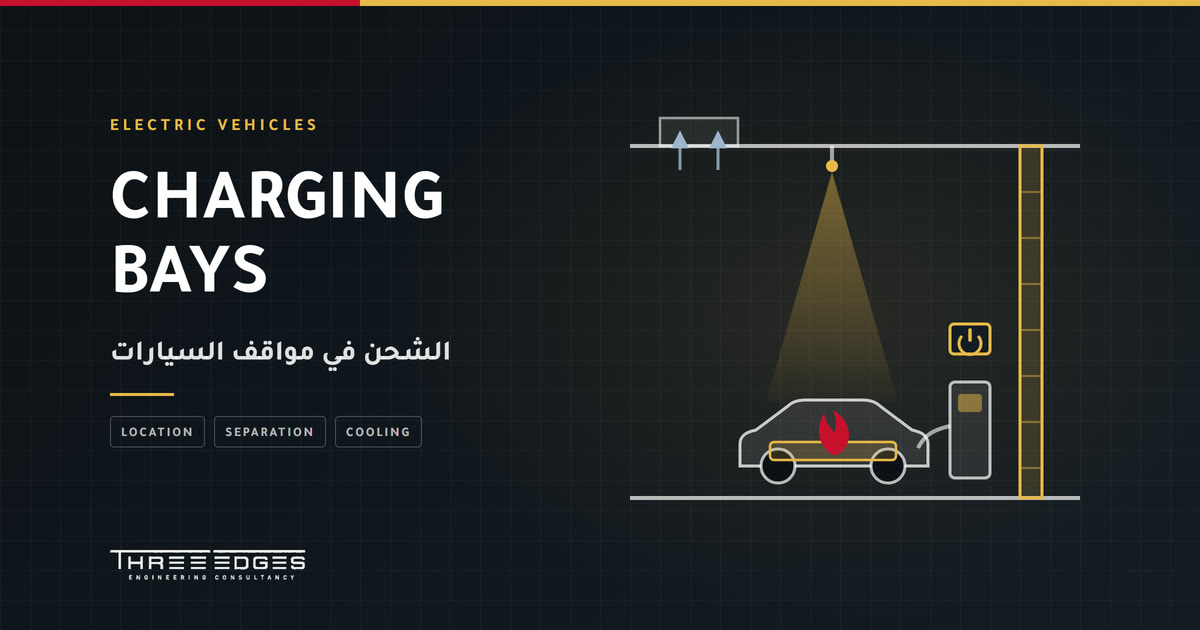
EV Charging in Car Parks: What Changes for Fire Safety
Installing electric vehicle chargers in an existing car park looks like an electrical decision: a supply point, a board and a charging unit. In reality it touches the fire safety strategy of the whole building, especially where the car park is a basement or sits beneath occupied space.
This article sets out what actually changes, and which decisions belong before installation.
Why a battery fire is different
- Thermal runaway: a reaction inside the cell generating heat and gases faster than natural cooling can remove them, propagating from cell to cell.
- Longer duration: the incident does not end when the flame is knocked down; it can continue and re-ignite hours later.
- Cooling is the control: gaining control depends on sustained cooling of the battery pack, which conventional systems find hard to deliver to the degree needed.
- Less dependent on oxygen: smothering tactics are less effective, so structural isolation and separation matter more.
- Toxic and flammable gases that accumulate in enclosed spaces.
The first decision: where do the chargers go?
Available guidance sets out a clear order of preference:
- Open car parks and unenclosed roof levels.
- Open-sided floors with good natural ventilation.
- Enclosed car parks and basements — the hardest case, calling for a full package of measures where there is no alternative.
The further down that order you go, the greater the demands on separation, detection, suppression and ventilation.
Separation and compartment size
The aim is that an incident involving one vehicle does not extend to a whole row, or to the building above. The usual means:
- Grouping charging bays in a defined, known area rather than scattering them.
- Rated construction separating the charging area from the rest of the car park, and the car park from the building.
- Considering charger positions relative to escape doors, firefighting routes and service shafts.
- Keeping storage and waste away from charging positions.
The required values — the resistance period, the number of vehicles in a compartment — differ between references and authorities, and some figures in circulation have no published basis. They are therefore settled with the authority and the insurer before design.
Sprinklers and the water supply
Having sprinklers in the car park does not mean they remain adequate once chargers are added. The practical question is whether the water supply can sustain a longer duration than the original design scenario. This is the item most often overlooked in retrofits, and it calls for a review of tank capacity, pumps and the design area.
Ventilation and smoke
In an enclosed car park heat and gases accumulate, and both detection and firefighting become harder. The system needs:
- Smoke extract designed for a vehicle fire scenario, with performance verified by simulation where needed — we covered this in smoke modelling for atriums and car parks.
- Operational ventilation able to deal with gases vented by a battery before ignition.
- Recognition that in a basement, smoke leaves through the same routes firefighters use to enter.
Detection and charger shutdown
- Early detection suited to the car park environment, tied into the building system.
- Chargers shutting down automatically on alarm or on any fault, as part of the cause-and-effect matrix.
- A clearly marked manual isolation point known to the operations team and to Civil Defense.
- Charger locations identified on the fire safety plans and at the control panel.
An existing car park: a short checklist
- The proposed charger location and the car park classification: open, open-sided or enclosed.
- The existing separation between car park and building, and the state of penetrations and doors.
- Whether the sprinkler system and water supply can carry a longer scenario.
- Ventilation and extract capability against a vehicle scenario.
- Connection of the chargers to the alarm system, and a manual isolation point.
- Updating the emergency plan, training the site team, and informing the authority.
How Three Edges can help
- The fire and life safety strategy for the car park and the building it serves.
- Reviewing the protection systems design: sprinklers, water supply, detection and interlocks.
- Assessing existing car parks before chargers are added.
- Coordinating with the authorities to get the solution approved.
Frequently asked questions
Are electric vehicles more dangerous than others?
Comparisons of incident rates are contested and the figures in circulation do not settle it. But the nature of the incident is different: longer, harder to extinguish, and more likely to re-ignite. Design responds to that nature, not only to the probability.
We only have one charger — is all of this necessary?
Requirements scale with number and location. But even a single charger in a basement deserves a review of its position, its separation, and shutdown on alarm.
Is an extinguisher near the charger enough?
An extinguisher helps with an early surface fire; it does not address thermal runaway inside the battery. Relying on it alone is not sufficient.
The requirements keep changing — how do we handle that?
This is a field where references are evolving quickly. The practical approach is to document the solution and its justification, have it accepted by the authority, and revisit it whenever the requirements are updated.
Planning to add chargers, or managing a car park that already has them? Request a fire safety review and we will set out the gaps and their priorities.
References
- European guideline on fire safety recommendations for electric vehicles
- Risk control guide: electric vehicle charging and enclosed car parks
- NFPA 88A — Standard for Parking Structures, and NFPA 13 for sprinkler systems
