Blog
Integrated Systems Testing: Where Two Years of Errors Surface
A familiar scene at the end of any project: the alarm contractor tests the detectors and they work, the HVAC contractor starts the fans and they spin, the lift contractor tries the recall and it succeeds. Every system is sound on its own. Then a single call point is operated on a single floor, and it becomes clear the building does not respond the way it should.
The reason is that fire safety in a building is not the sum of its systems; it is one agreed behaviour. Integrated testing is the only way to prove that behaviour exists.
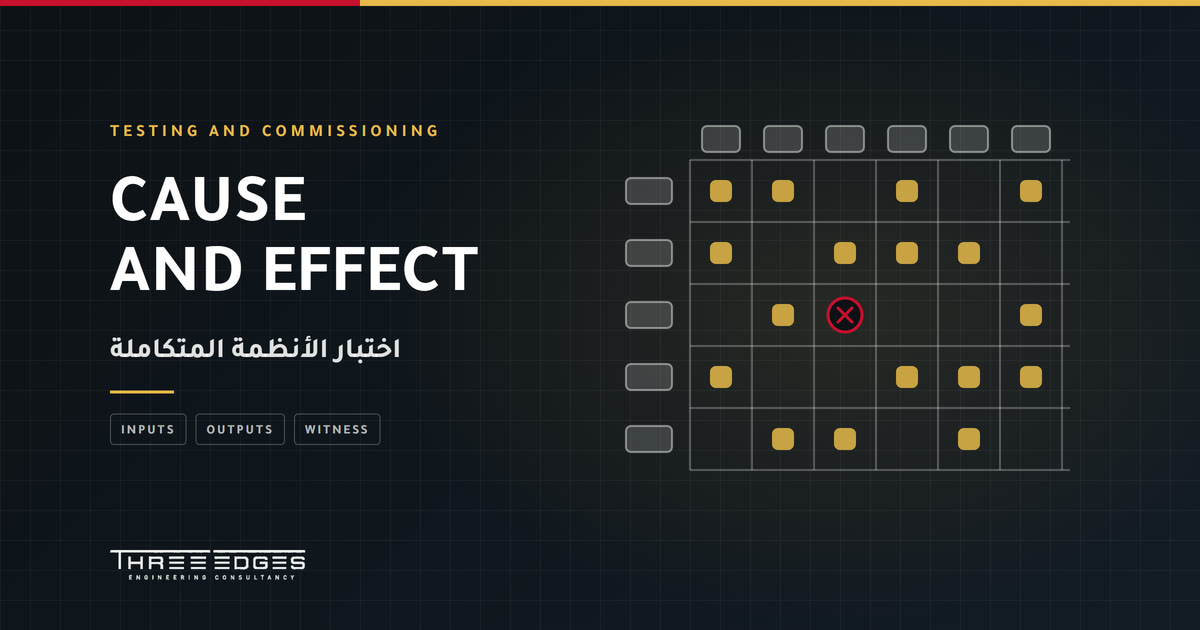
The cause-and-effect matrix governs everything
Before any test there has to be an approved matrix stating, for each input, exactly what happens: which event in which zone produces which outputs. It is not a formality:
- It is written at design stage, not the week before handover.
- It is reviewed and approved by the owner, the consultant and the authority.
- The panels are programmed from it, and the test plan itself is built on it.
Without it, testing becomes an attempt to infer the designer's intent from the panel's behaviour — which is exactly what happens on many projects.
What actually gets tested
An integrated test follows the signal from its source to its last effect in the building:
- Detection and alarm: the correct voice message in the correct zone, and in the adjacent zones.
- Release of magnetically held fire doors, confirming they actually close and latch.
- Closure of fire and smoke dampers in the ductwork, and extract and pressurization fans starting in the right sequence.
- Lift recall to the designated floor — and confirming it is not the affected floor.
- Release of access-controlled doors on escape routes.
- Fire pump starting, and flow and valve supervisory signals.
- Fuel and power shutdown in kitchens, and gaseous system discharge with its interlocks.
- Signalling to the control room and to the external monitoring station.
This is completed by measurements: stair pressure differentials, door opening forces, and sound level and message intelligibility in the various spaces.
Findings that recur on every project
- A damper wired to the wrong alarm zone, closing in the wrong wing.
- Fire doors that do not fully latch after release, because of hinge or floor adjustment.
- Pressurization above the limit, making the stair door almost impossible to open.
- Fans running in reverse order, or extract operating with no make-up air.
- Access-controlled doors that stay locked on alarm.
- Voice messages that are unintelligible in reverberant spaces.
- A graphic panel showing zone names that do not match the building's signage.
Not one of these is found by testing a system on its own.
When and how it is done
- A desktop review of the matrix, the shop drawings and the programming before any site test.
- Partial tests of each system as it is completed, with records.
- The integrated test to a written test script, witnessed by the owner, the consultant and the contractors' representatives.
- A snag list that is cleared, followed by a retest of the affected items.
- A handover file containing the approved matrix, the test records, the as-built drawings, the operating and maintenance manuals, and training for the facility team.
We prefer the test to be run by a party independent of the installers, because whoever installed the system is not the best judge of it.
And after handover?
The matrix is a living document. Any change to partitions, air conditioning, access control, or a new tenant fit-out can break the response chain. So the test is repeated periodically and after any change, and the matrix is updated rather than left as an old copy in a file. We covered what belongs in an alarm design package in the fire alarm design package.
How Three Edges can help
- Preparing and reviewing the cause-and-effect matrix and the fire alarm design.
- Reviewing the protection systems design and the testing and commissioning plan.
- Assessing existing systems and re-verifying the integrated response.
- Coordinating with the authorities and attending acceptance tests.
Frequently asked questions
Isn't this the contractor's responsibility?
The contractor is responsible for their system. The building's overall response needs a party looking across all of them, and an approved document to measure against.
How long does an integrated test take?
It depends on the size of the building, the number of zones and the scenarios. What matters most is not compressing it into one day before handover, because clearing findings and retesting takes time.
What about an existing building that was never tested this way?
You build it backwards: document what exists, produce a realistic matrix, run a test that exposes the gaps, then a prioritised remediation plan.
Is testing a sample of detectors enough?
A sample suits device verification, but the response scenarios are tested for every zone and every output, otherwise wiring errors stay hidden.
Approaching handover, or managing a building whose response you do not trust? Request a fire safety review and we will set out the gaps and their priorities.
References
- NFPA 72 — National Fire Alarm and Signaling Code, inspection and testing requirements
- NFPA 3 — Recommended Practice for Commissioning of Fire Protection and Life Safety Systems
- Saudi Fire Code SBC 801 — Saudi Building Code portal
