Blog
Fire During Construction: The Building's Protection Is Installed Last
On any project, the fire protection systems go in last: sprinklers, alarm, fire doors, pumps. Months before that, the building has filled up with timber, insulation, paints and solvents, with dozens of people working in it using welding and cutting equipment.
The result is a simple paradox: the highest fire load and the most ignition sources, in exactly the period when protection is at its lowest. That is why construction fire safety is a subject of its own, not a clause in the contractor's package.
Hot works: the permit is not a piece of paper
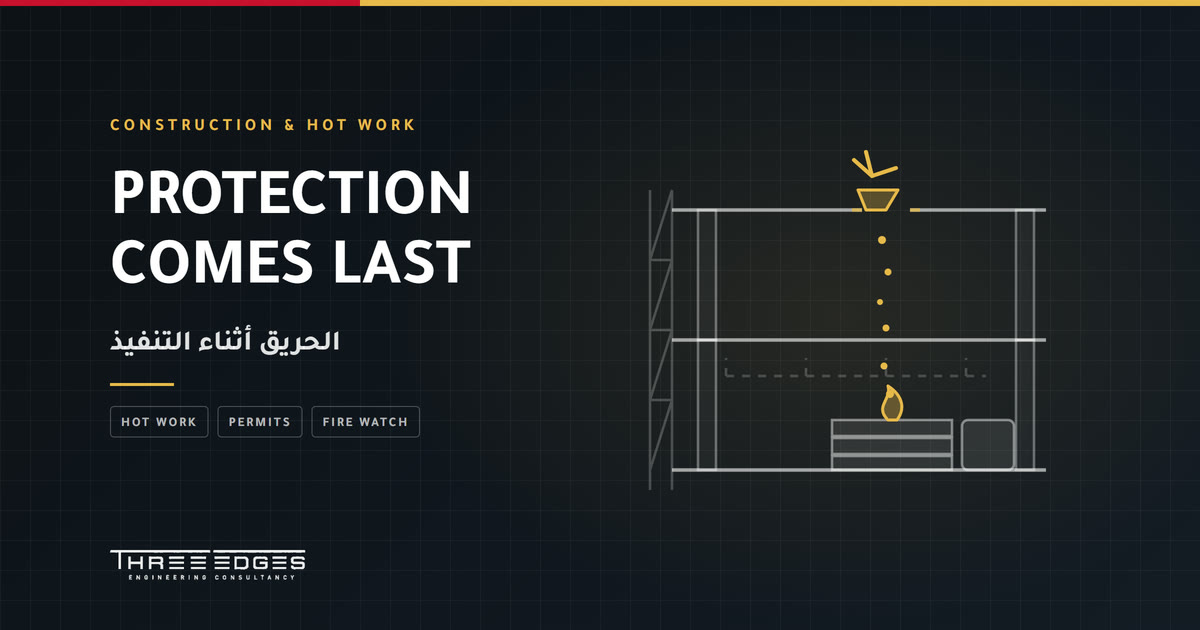
Welding, cutting, grinding and pipe soldering are the best-known cause of site fires, and usually nothing ignites while the work is happening — it ignites an hour or more after the crew leaves, from a spark that fell into a void or under a layer of insulation.
A permit system that works includes: a defined place and time, inspecting the area and removing or covering combustibles, blocking openings a spark could fall through, firefighting means on the spot, a fire watch during the work, and a continued watch after the work finishes for long enough before the area is shut up.
What burns on a construction site?
- Formwork and timber: huge quantities, spread across the floors.
- Insulation: thermal and waterproofing, some of it highly combustible before it is covered.
- Paints, solvents and adhesives: usually stored in the nearest room, with no ventilation.
- Finishing waste: accumulating in the stair or the shafts because that is the nearest place.
- Gas cylinders: oxygen, acetylene and the workers' own cooking gas.
- Generators and their fuel, and temporary power run and extended with no drawing.
- Workers sleeping in the building — common, and it adds a sleeping occupancy to a site with no protection.
A fire plan for the site, not only for the building
The site needs its own plan for the whole construction period:
- A water supply for firefighting during construction, with the riser commissioned early and extended as the floors rise, so Civil Protection can use it.
- An access route for the fire appliance that stays clear despite materials and scaffolding.
- A protected escape stair, defined and lit, even if temporary, and not used for storage.
- A temporary alarm — even a manual means of raising it with a clear procedure — because the permanent system is not live yet.
- An assembly point and a head count, which is the hardest part on a site whose labour changes daily.
- Organised storage of hazardous materials away from the building and the escape routes.
The hardest case: refurbishment inside an occupied building
Work inside a running hospital, a hotel with guests, an open mall, or one floor of a residential tower. Here a construction site coexists with people who have nothing to do with the work and do not know the protection has been disabled.
What is needed is written compensatory measures: a real separation of the work area, a record of which systems are disabled and who restores them at the end of each day, human watch replacing a disabled detector, and confirmation that the occupants' escape routes are unaffected. It extends what we covered in tenant fit-outs.
Handover: when does the dangerous period end?
It ends when the systems are commissioned and tested together, not when they are installed. The gap between "installed" and "working" is what we discussed in testing and commissioning integrated systems. A project handed over and occupied before that step is complete begins life with a gap in it.
How Three Edges can help
- A fire and life safety strategy that covers the construction stage, not only the finished building.
- Fire safety and evacuation plans for the site during construction and for refurbishment phases.
- Reviewing the systems and the sequence in which they are brought into service.
- Coordinating with the authorities during construction and at handover.
Frequently asked questions
Who is responsible for site fire safety?
The contractor executes, but the owner carries the consequence of a fire. So the requirements are written into the contract and followed up, not left to site judgement.
How long should the watch continue after welding?
Long enough to catch a delayed ignition, set in the permit procedure according to the work and the location. What matters is that the area is not shut up the moment the work stops.
Can the alarm system be disabled during works?
A defined part can be isolated under a written procedure with a human alternative, for a defined period that ends with the working day. Open-ended isolation is not acceptable in an occupied building.
Is it acceptable for workers to sleep in the building?
It adds a sleeping occupancy to a site without complete protection, and it is among the most dangerous arrangements. If unavoidable it needs separation, an alarm, an escape route and night supervision.
Running a project, or a refurbishment inside an occupied building? Request a fire safety review and we will set out a plan for the transitional period.
References
- The Egyptian code for design and execution requirements for protecting facilities from fire
- NFPA 241 — Safeguarding Construction, Alteration, and Demolition Operations
- NFPA 51B — Fire Prevention During Welding, Cutting, and Other Hot Work
