Blog
Water Supply and Fire Pumps: The System Nobody Sees Until It Fails
Everything we call a suppression system — sprinklers, hose reels, hydrants, the brigade inlet — ends at one question: does water reach the furthest point at the required flow and pressure, for long enough?
And that is the one part of a fire protection system nobody looks at and nobody asks about, until the day it is needed for real.
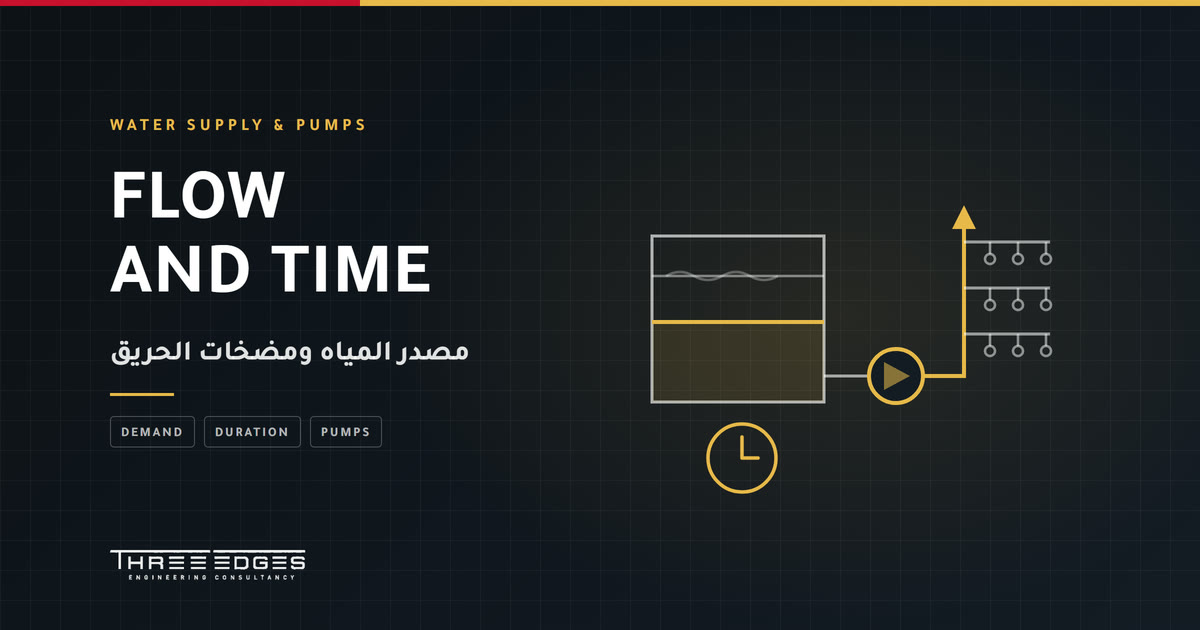
Three numbers govern everything
- Flow: the litres per minute the worst credible operating case needs — the number of sprinklers expected to operate together, plus the hose stream allowance.
- Pressure: what is required at the most remote and highest sprinkler, plus friction losses and static lift.
- Duration: how long that flow must be sustained — which is what sizes the tank.
The common mistake is to start from whatever tank the project already has and build the system around it. The correct order is the reverse: hazard classification sets the design density, density sets the flow, and flow with duration sets the tank.
The tank: dedicated, not shared
A fire tank is not the building's tank. Where storage is shared with normal use, there has to be an arrangement that keeps the fire volume reserved no matter what daily consumption does — domestic draw-off taken from a higher level, never from the bottom.
We often meet tanks sized for a building whose activity then changed: a store that became high-piled, a floor that became a kitchen, an area that was added. The hazard classification changed; the tank did not.
Pumps: starting is not performing
A pump set is usually a duty pump, a standby, and a small jockey pump holding pressure. The questions that get skipped:
- The driver: electric or diesel? If electric, is the supply reliable, independent, and not cut when the building's power is isolated?
- Suction: flooded suction, with the tank above the pump, is the preferred arrangement. Suction lift needs special provisions and is a recurring source of failure.
- The curve: a pump turning on test is one thing; a pump delivering the required flow and pressure is another. It is measured in flow and pressure, not by the sound of the motor.
- Fuel: a diesel pump with an empty or stale fuel tank is not a standby pump.
The pump room is not a store
A pump room needs separation from the rest of the building, direct access, ventilation, drainage, lighting and real space to work in. What we find in practice: a room locked with one person holding the key, or full of boxes, or boxed in by a later extension.
What Civil Protection reaches first
The brigade inlet and the hydrants are the first things a fire crew uses. They belong on the appliance route, visible, labelled, and not blocked by parked cars or a wall added later — an extension of what we covered in fire safety at masterplan stage.
Acceptance testing: the difference between installed and working
A system is not accepted because it was installed. Acceptance testing runs the pump across its flow range — including a point beyond its rated flow — measures the pressure at each point against the approved curve, and tests automatic start, changeover to standby, and the alarms. It is part of the integrated handover we set out in testing and commissioning integrated systems.
What we find most often in operating facilities
- A closed valve on the supply — the simplest fault and the most dangerous.
- A tank below what is required after a change of use or an extension.
- A diesel pump with no fuel or a flat battery.
- No documented routine test, so nobody knows the state of the system.
- A brigade inlet behind a wall or inside a car park.
How Three Edges can help
- Reviewing the suppression systems design, with the water demand and pump calculations.
- Assessing the existing system against what has changed in the operation.
- Codes and standards compliance and fixing the reference for the project.
- Masterplan review for the water supply and access outside the building.
Frequently asked questions
Can I use the building's ordinary tank for firefighting?
Under conditions: the fire volume has to be genuinely reserved and untouched by daily use, with assured make-up and maintenance.
Is one pump enough?
Standby capacity matters because a single pump is a single point of failure for the entire system — more so the larger or taller the building.
How often are pumps tested?
A short regular routine test, and a longer performance test at wider intervals, with the results recorded. An undocumented test may as well not have happened.
We expanded the factory — should I revisit the water supply?
Yes, and it is the first thing to revisit. An expansion usually changes the required flow, and may need a larger tank or pumps.
Building a facility, or running one and unsure of the state of its water supply? Request a fire safety review and we will start from the three numbers.
References
- The Egyptian code for design and execution requirements for protecting facilities from fire
- NFPA 20 — Installation of Stationary Pumps for Fire Protection
- NFPA 22 — Water Tanks for Private Fire Protection, and NFPA 24 — Private Fire Service Mains and Their Appurtenances
