Blog
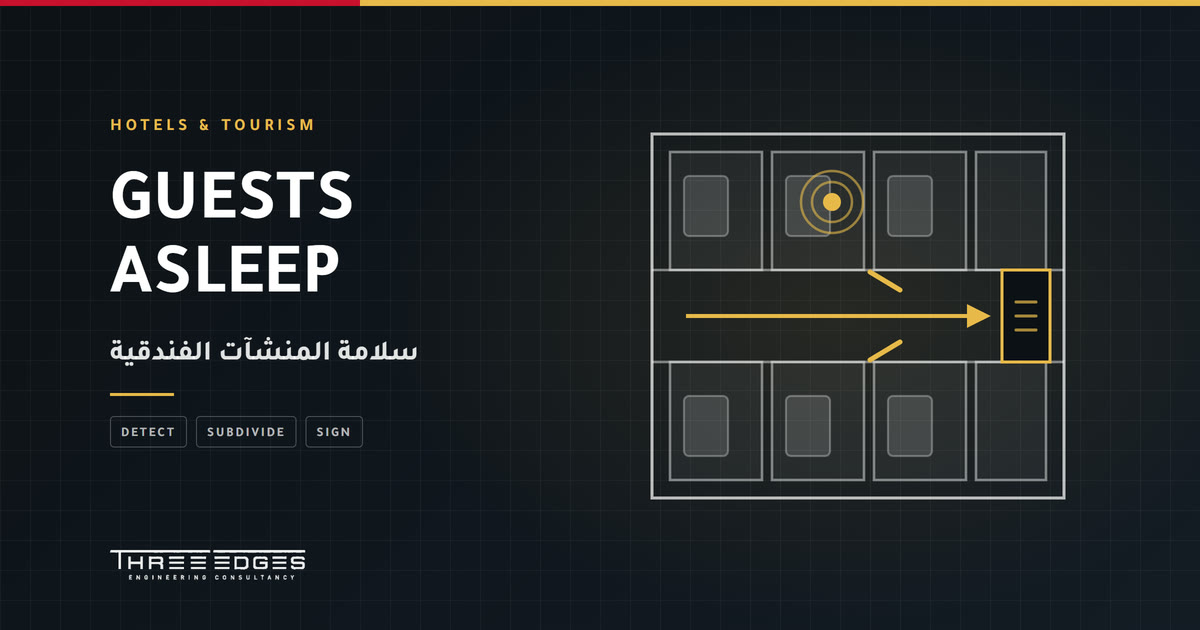
Hotels and Tourism Facilities: Safety When the Guest Is Asleep
In an office building the occupant knows the building, is awake, reads the language on the signs, and has probably been through a drill. In a hotel, none of that holds: the guest is asleep, in a building they arrived at yesterday, may not read Arabic, and has no idea where the second stair is.
That difference alone changes how safety is designed and operated. This article sets out what actually changes, and what Egypt's code for existing hotel establishments covers.
A separate reference for existing establishments
Recognising how hard it is to apply new-build requirements to hotels that have been standing for decades, Egypt issued a code specifically for protecting existing hotel establishments from fire, by a decision of the Minister of Housing in 2019, prepared with the Chamber of Hotel Establishments, the National Housing and Building Research Centre, Civil Protection and the Ministry of Tourism.
It covers the items that form the backbone of safety in any hotel: means of escape, water supplies and pumps for firefighting, the firefighting network, portable extinguishers, smoke extraction, detection and alarm systems, and electrical distribution boards. There are also particular provisions for older building stock and for existing high-rise buildings.
A practical point: confirm the edition in force and any later amendments before building a plan on it. Working from a press summary or an old copy is a recurring source of surprises.
What changes because the guest is asleep
- Detection inside the rooms: early detection in the bedroom is not a luxury; it is what buys a sleeping person the time they do not have.
- An alarm audible through sleep: sound that reaches inside rooms and bathrooms, not just the corridors.
- A message people understand: a voice alarm with a clear message, in more than one language in tourism facilities, beats a bell that gets read as a fault.
- A route that needs no thinking: illuminated signage, emergency lighting, and a plan on the back of every room door. The guest will not search for an exit; they will follow what they can see.
- Room doors: self-closing, acting as the first barrier between the room and the corridor.
- Horizontal compartmentation: the long corridors of a spread-out hotel need subdivision to stop smoke running the length of the floor.
The hazards are not in the guest rooms
Most fires do not start in a guest room:
- Kitchens: the most frequent source, with their own protection package, which we covered in commercial kitchen fire protection.
- Laundry and linen stores: a large fire load in an enclosed space.
- Boiler and generator rooms, and fuel stores.
- Function halls: high and variable occupancy, temporary decor, and sometimes pyrotechnics or effects.
- Spread-out resorts: low buildings scattered over a large site — the issue is not height but access distances, water supply, and how long the fire service takes to arrive.
Operations: half the system
In a hotel, the response in the first minutes comes from whoever is actually on duty — usually at night, and in smaller numbers.
- A short written procedure for each role, not a manual nobody reads.
- Training on every shift, and drills that include the night shift.
- Who receives the alarm? Who verifies? Who calls? And after how many minutes does evacuation start if nobody has verified?
- A procedure for guests with reduced mobility or particular needs, known at reception.
- Control of alterations: a hall partitioned, a store turned into an office, an exit closed "temporarily" for the season.
We set out how a plan turns from a sheet on the wall into real training in evacuation plans and drills.
How Three Edges can help
- The fire and life safety strategy for the hotel: compartmentation, evacuation, and night-time scenarios.
- Assessing existing facilities on site, with a remediation plan prioritised around the season and the budget.
- Fire safety and evacuation plans for the floors and the rooms.
- Coordinating with the authorities to get the remediation plan accepted.
Frequently asked questions
The hotel is old and a stair cannot be added — what then?
The existing-building route allows documented compensatory measures: faster detection, better compartmentation, controlled occupancy, operational procedures. The condition is that they rest on engineering reasoning and are accepted, not assumed.
When do we close the hotel to do the work?
Usually you do not. The plan is split by wing and floor and carried out off-season, provided the interim measures are controlled while work is underway.
What is the most common finding in hotels?
Exits and stairs used for storage or locked for security reasons. The cheapest thing to fix and the highest impact on life safety.
Do insurers ask for the same things?
Insurers may require more than the regulatory minimum, particularly for property protection. Better to know their requirements before the plan is fixed than after.
Running a hotel or resort and want to know where it stands before the season? Request a fire safety review and we will start with a report that sets the priorities.
References
- The Egyptian code for protecting existing hotel establishments from fire — Minister of Housing decision 526 of 2019
- The Egyptian code for design and execution requirements for protecting facilities from fire
- Akhbar El-Yom — the Egyptian code for protecting tourism establishments
