Blog
Residential Towers: A Building With No Management and Occupants Who Never Drill
A mall has an operations team. A hotel has night staff. A factory has a safety officer. A residential tower has none of that: no team, no drills, nobody testing the alarm panel, and occupants of every age and ability — asleep, at home, and among them people who cannot get down a stair unaided.
So safety in a residential building rests on one thing before any system: the fire staying inside the flat it started in.
Compartmentation is the strategy
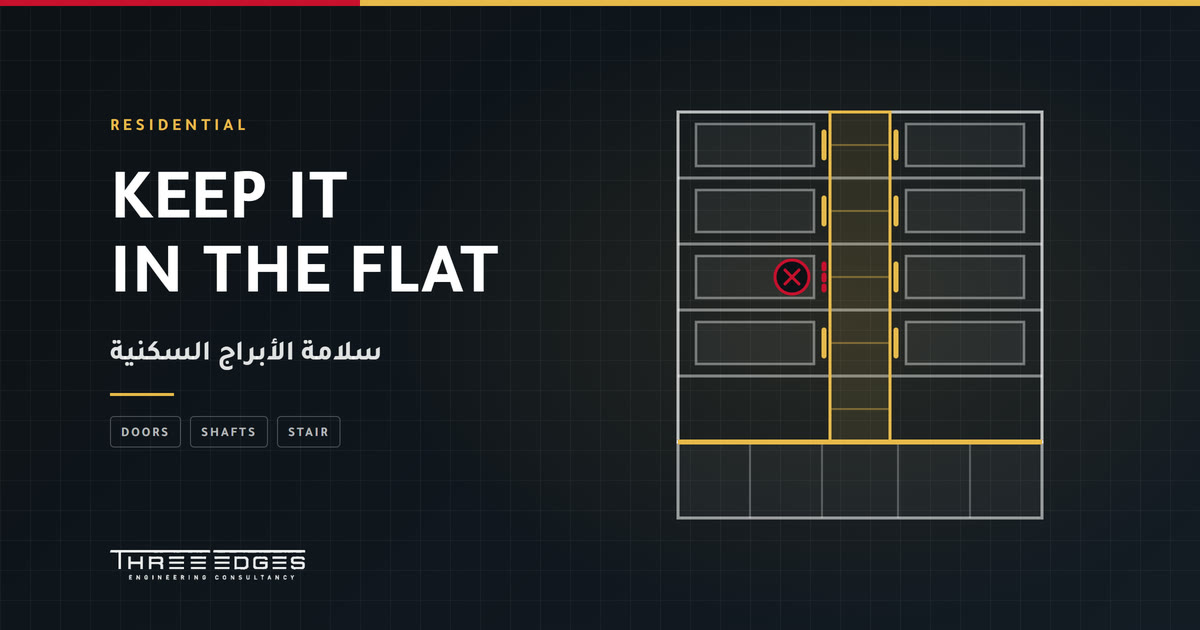
The idea residential is built on: every flat is its own fire-resisting compartment, and the stair and lobby are protected. If that holds, the whole tower does not need to come down the stairs because of a fire in one flat — and anyone who cannot come down stays somewhere that is genuinely safe.
If it does not hold, the whole logic collapses: smoke fills the stair, and both staying and leaving become dangerous.
Which is why the three most important items in any residential tower are not systems but construction:
- The walls and floors separating the flats, and every penetration through them sealed — the most common problem of all, covered in firestopping and fire barriers.
- The flat entrance door: the barrier between the fire and the stair. A fire-rated, self-closing door — not a handsome decorative one.
- The stair and lobby: protected, with smoke ventilation, and doors that actually close.
What residents undo — in good faith
A tower is handed over compliant, then changes at the hands of the people living in it:
- Swapping the rated flat door for a nicer one, or removing the self-closer because "it bangs".
- Opening up a separating wall, or running air conditioning pipework through it without sealing the penetration.
- Storing belongings on the stair landing or in the lobby — the single most repeated finding in residential buildings.
- Closing the stair's smoke vents to keep dust out.
- Splitting a flat into furnished units, changing the occupancy and with it the requirements.
- Adding work to the facade or balconies in materials that entered no assessment — see facade fire safety.
And because there is no operations team, none of it gets noticed until an inspection or an incident.
The basement: the hazard under the tower
Most towers sit over a car park, and a vehicle fire in an unprepared basement fills the vertical shafts with smoke. Electric vehicle charging raises it further, as covered in EV charging in car parks. What is needed: effective separation between the car park and the building, smoke ventilation, and sealed shafts and lift wells.
An existing tower: where to start
- Stairs and lobbies: clear, doors closing, exits discharging outside.
- Flat doors: a survey of their condition — the simplest measure with the highest impact in a residential building.
- Penetrations: in shafts, meter cupboards and air conditioning routes.
- The alarm: does the panel work, and who tests it each month?
- The car park: separation and ventilation.
- Facade and balconies: materials added after handover.
Who is responsible?
This is the question that stalls everything in residential. Operation is the responsibility of the owners' association or the managing company, and without a clear party running periodic testing, maintenance and control of alterations, the building's safety erodes gradually with nobody noticing. Setting that responsibility down in writing — who tests, when, and who approves alterations — matters more than any equipment bought.
How Three Edges can help
- A fire and life safety strategy for the tower: compartmentation, stairs, and the stay-or-leave logic.
- Assessing existing buildings, with a survey of barriers, doors and penetrations.
- Code compliance for what applies to existing high-rise buildings.
- Fire safety plans for floors, shafts and assembly points.
Frequently asked questions
On the alarm, do we leave or stay in the flat?
It depends on the building. Where compartmentation is sound and the stair protected, staying is safe for anyone not in the affected flat. But that is a decision made from an assessment of the building and communicated to residents in advance — not left to each resident to work out during an incident.
Our tower has a single stair — is that a breach?
It depends on the height, the date of construction and the requirements that apply. In existing buildings it is offset by improving compartmentation, ventilating the stair, and earlier detection.
Who pays for the remediation?
Common parts fall to the owners collectively, and the flat door to its owner. Failing to agree that is why most remediation plans in residential towers stall.
The alarm keeps going off for no reason — can we isolate it?
No. False alarms are solved by maintenance and relocating detectors, not by isolating the panel. An isolated panel means a building with no alarm at all.
Managing a residential tower or an owners' association and want to know where it stands? Request a fire safety review and we will start with a report setting out the priorities and the likely cost.
References
- The Egyptian code for design and execution requirements for protecting facilities from fire — including its requirements for existing high-rise buildings
- Unified Building Law 119 of 2008 and its executive regulation
- NFPA 101 — Life Safety Code, residential occupancy chapters
