Blog
Rooftop Solar: The Roof Is No Longer Empty
A roof used to be empty space a firefighter climbed onto to cut ventilation openings or work from above. Today it is covered in modules, cabling, inverters and sometimes battery storage.
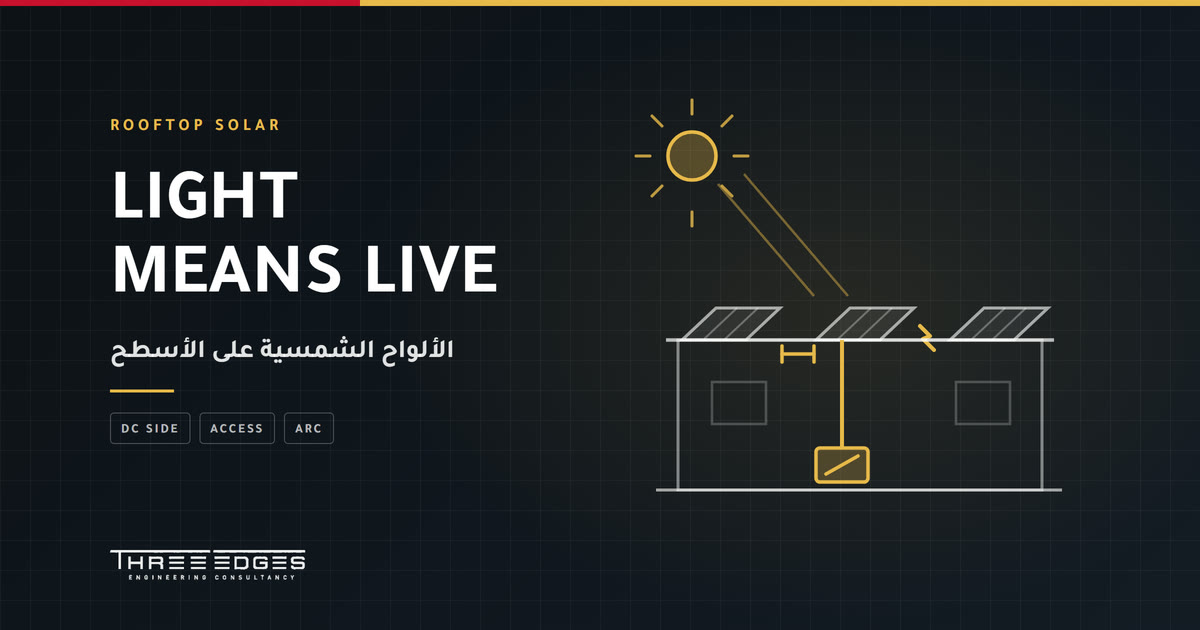
The fundamental difference with a solar array is not that it might catch fire — that is unlikely — but that it cannot be switched off: a module generates voltage while light falls on it, even with every breaker in the building open.
The DC side: what the breaker does not isolate
Opening the building's main breaker isolates the AC side only. The cables running from the modules to the inverter keep carrying high DC voltage all day, and sometimes under moonlight or firefighters' floodlights.
Three practical consequences follow:
- The voltage detection devices fire crews carry usually cannot detect DC, so they cannot be relied on to judge a route safe.
- Cutting a cable or putting a saw through a module in daylight is a dangerous act.
- Rapid shutdown or hazard-control arrangements shrink the energised zone to the array boundary, but they do not de-energise the modules themselves. Misunderstanding that point is the single most dangerous thing here.
Arcing: the best-known cause of fires
Most PV system fires do not start in a module, they start in a connection. A loose plug connector, two connectors from different makers mated together, or a poor crimp produces a contact resistance that heats up progressively until a sustained arc forms — and DC does not self-extinguish the way AC does.
So the quality of the installation and its connectors, plus arc-fault detection at the inverter, matter more than any other item in the system.
The roof itself: three questions before installation
- Loading: can the roof carry the system and its ballast? And can it still carry them once a fire has weakened the structure?
- Pathways: walkways and clear areas are needed around the array, at the edges and around stair openings — so a firefighter can reach, work and get out.
- The roof build-up: insulation under the array and over the deck is part of the fire load, and the array can trap heat and block natural ventilation.
This matters most over factories and warehouses with large roofs, where enormous areas are covered by one continuous system — the same buildings whose protection we discussed in warehouses and sprinklers.
Isolation the firefighter can actually reach
The isolation device has to be somewhere a fire crew can reach from ground level, near the main supply panel, clearly labelled — not on the roof and not inside a locked room. Alongside it:
- Signage at the building entrance and on the electrical panel stating that a PV system is present and where its cables run.
- A simple drawing of the array, inverters and isolation points, available to Civil Protection.
- DC cabling routed outside the building wherever possible, with the shortest run inside it, because any arc in those cables happens inside an enclosed space.
Batteries: an entirely separate hazard
Adding lithium storage to the system changes the nature of the risk completely: thermal runaway, flammable gases, and re-ignition after the fire appears to be out. We covered those characteristics in the context of electric vehicles in EV charging, and the same logic applies: a separated location, ventilation, distance from escape routes, and prior coordination with Civil Protection.
Operation and maintenance
In a hot, dusty environment modules get dirty, connections run hotter, and combustible material can gather under the array. Periodic inspection — including thermal imaging of connections and boards — is what finds the problem before the arc, not after it.
How Three Edges can help
- Reviewing the system from the safety side: isolation, pathways, cabling and detection.
- A fire and life safety strategy for the building once the array is added.
- Assessing an existing installation and what it changed in the building's risk.
- Coordinating with the authorities on access and isolation arrangements.
Frequently asked questions
Can the system be fully shut down during a fire?
Module output cannot be stopped while light falls on them. What can be done is to shrink the energised zone and isolate everything beyond it, which is what rapid shutdown arrangements do.
What causes most fires?
Connectors and DC-side components, not the modules. Installation quality matters more than the brand.
Should I leave gaps between the panels?
Yes — walkways and clear areas for access, working space and ventilation. Covering the whole roof is a decision to be reviewed against access requirements.
We already have a system — what do we check first?
That a clearly labelled isolation device exists where the brigade can reach it from the ground, the signage, and the state of the connections by thermal imaging.
Planning a rooftop array, or already running one? Request a fire safety review and we will assess what it means for the building's safety.
References
- The Egyptian code for design and execution requirements for protecting facilities from fire
- NFPA 1 — Fire Code, roof access and pathway requirements for buildings with PV systems
- IEA-PVPS Task 12 — Photovoltaics and Firefighters' Operations, and UL 3741 for PV hazard control
