Blog
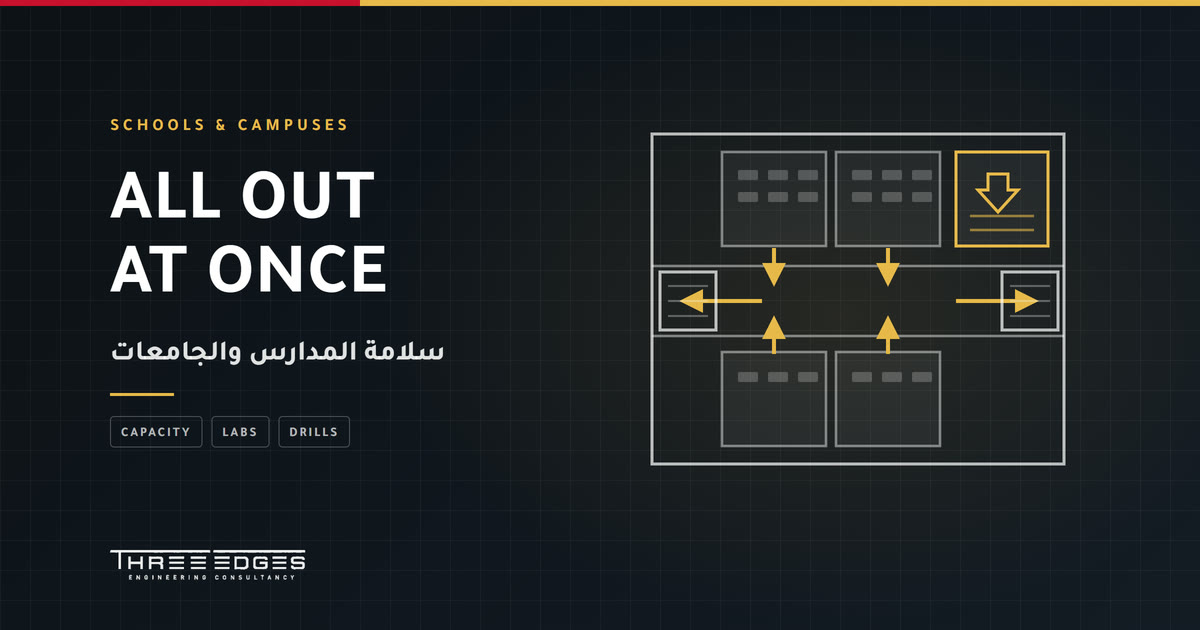
Schools and Universities: Hundreds Out in Minutes, and Age Changes Everything
A school is one of the best-performing buildings in an evacuation — and one of the worst if it has never drilled. Hundreds of people in one building, but organised into groups with a responsible adult attached to each. That is an ideal structure for getting out quickly, provided everyone knows what to do before the alarm sounds.
At the same time, age changes everything: a secondary class leaves on its own in minutes; a nursery class only leaves carried.
Age sets the strategy
- Nurseries and kindergartens: closer in logic to healthcare than to a school — children who do not evacuate themselves. That means ground floors wherever possible, higher supervision ratios, means of moving several children at once, and shorter escape distances.
- Primary: evacuates as a group with the teacher, and needs a route that is clear and simple, with no decisions in it.
- Preparatory and secondary: they move fast, and the risk shifts to congestion at the stairs rather than a slow start.
- Universities: closer to public buildings — variable occupancy, occupants who belong to no fixed group, and large halls.
What governs the design
- Exit and stair capacity: a school usually evacuates all at once, so stairs are sized for simultaneous flow, not phased.
- Corridor width: a corridor serving several classrooms empties all of them at the same moment.
- Which way doors swing: classroom and exit doors open in the direction of travel.
- Two exits per floor, distributed so one incident cannot take both, with travel distances within the limits.
- Assembly points: defined, known, and clear of the fire service access route.
- Alarm: audible in classrooms, halls, covered courts and toilets.
Where the building is large or the stairs are limited, the times are calculated with egress modeling rather than assumed.
Where fires actually start
A fire rarely starts in a classroom. The real places:
- Chemistry laboratories: flammable materials and heat sources — needing separation, proper storage, and a means of isolating gas and electricity at the door.
- Technical workshops: welding, materials, equipment.
- Kitchens and canteens: with their own package, as in commercial kitchen fire protection.
- Electrical rooms, generators and stores.
- Paper and activity stores: a large fire load that gets forgotten because it does not look dangerous.
Student accommodation: a different case entirely
A dormitory is not a school — it is a sleeping occupancy, and the logic that applies is closer to a hotel: detection inside the rooms, an alarm that wakes people, self-closing room doors, subdivision of long corridors, and a night procedure with fewer staff. We set out that logic in hotel and tourism facility safety.
Drills: the highest return for the lowest cost
Nothing in a school pays back like a serious evacuation drill:
- Run on a regular cycle, and at different times — not always in the first period.
- With scenarios: a blocked exit, or a fire in the main stair.
- Timed and recorded, and compared with the previous drill.
- Pupils counted at the assembly point under a clear procedure, with someone named to check toilets and laboratories.
- Reviewed afterwards, with the plan amended — a drill that changes nothing was a performance, not training.
We set out how a plan becomes real training in evacuation plans and drills.
How Three Edges can help
- A fire and life safety strategy matched to the age group and the building type.
- Egress modeling for large buildings or ones with limited stairs.
- Fire safety and evacuation plans for classrooms, floors and assembly points.
- Assessing existing buildings, with a remediation plan that fits the holidays.
Frequently asked questions
How often should a drill be run?
On a regular cycle through the school year, with the number taken from the adopted requirement. What matters is that they are not all in the same conditions at the same time of day.
An old school building with a single stair — what then?
It is treated with existing-building logic: redistributing uses so smaller classes sit on the lower floors, improving detection, and documented, accepted compensatory measures.
Is the school bell enough as a fire alarm?
No. The lesson bell is a familiar sound meaning "class is over". The fire alarm has to be a different sound that everyone knows.
And the chemistry laboratory — what matters most?
A means of isolating gas and electricity at the exit, and separate storage for flammable materials with limited quantities kept inside the lab.
Running a school or campus and want it reviewed before the academic year? Request a fire safety review and we will start with a report that sets the priorities.
References
- The Egyptian code for design and execution requirements for protecting facilities from fire
- NFPA 101 — Life Safety Code, educational occupancy chapters
- NFPA 72 — National Fire Alarm and Signaling Code
